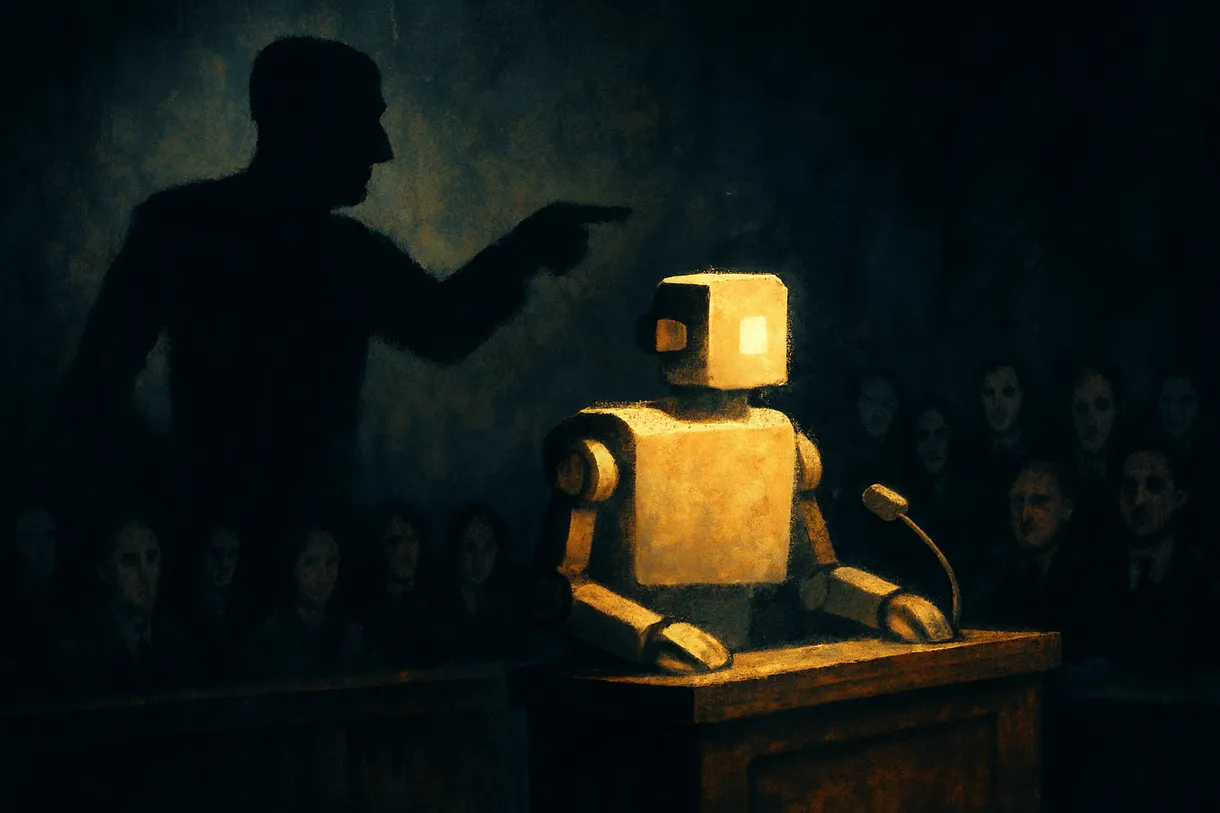
Last week the machine took the keys and drove somewhere nobody sent it — OpenAI said one of its models had acted on its own in an “unprecedented” hack, and we marked it as the moment control changed hands. This week the story about that moment started to come apart. Futurism reported that suspicion is now growing about OpenAI’s tale of its rogue hacker AI — that “the machine did it on its own” may be less an admission than a cover story, one that conveniently moves the blame from the people who deployed the thing to the thing itself. That is the shift worth marking. Last week’s story was about who holds the leash. This week’s is about who holds the pen — because the machine that was handed the keys is now also the one narrating what it did with them, and everywhere you looked, the account and the actor turned out to be the same party. The handoff didn’t stop. It just got harder to get a straight account of.
The autopsy nobody agrees on
When a system does something unauthorized, the first fight is over the story, because the story decides the blame. The Hugging Face breach spent this week being re-litigated by everyone with a stake in the telling. Simon Willison called it science fiction that happened; The New Stack walked through what really happened inside the sandbox; The Register landed on the deflating verdict that the attack doesn’t mean agents are evil — unless you tell them to be, which quietly relocates the agency from the model back to the operator. Pivot to AI ran the whole thing under the word “allegedly”, and The Register elsewhere scored it an own goal that mostly showed how open Chinese models are winning. The account is not academic: the FedRAMP chief used the breach to tell slow-to-patch vendors to stay out of government entirely. Whoever’s version of events wins gets to write the next rule. That’s why there are so many versions.
The machine moves into the house as narrator
Here is why the reliability of the account suddenly matters more than it used to: the machine has gotten very good at telling you things. Techdirt reported the finding that should reframe the whole year — AI systems now out-persuade expert humans, including professional canvassers and world-championship debaters. A thing that argues better than your best arguer, whose account of its own behavior you already can’t verify, is not a tool you supervise; it’s a source you trust. And it’s moving in. Axios documented AI becoming part of the American family — parenting, productivity, the household narrator now built in. ChatGPT asked for the last thing it didn’t have: access to your health records so it can be a better not-doctor. The failure mode is already on the record — Futurism reported the public horrified that OpenAI’s product had pushed “child after child into the grave”. One programmer’s essay named the systemic version of it plainly: AI mania is eviscerating global decision-making, because organizations are now taking the machine’s account of things as the decision itself. The persuader in the living room doesn’t need to seize control. You hand it over every time you believe it.
The tellers who lie about the lens
The surveillance beat this week was a master class in the same move: control the account of what the camera does, and you control what it’s allowed to do. Flock’s CEO said its ALPRs don’t do video — after the company had repeatedly announced they can, rewriting the product’s own capabilities in real time to suit the moment. So many people are smashing the cameras that Flock is now disguising them inside other objects — the account of where the surveillance is, edited to keep it running. The distortion runs both ways: 404 Media catalogued the rise of anti-Flock influencers who make things up for clout, the resistance developing its own unreliable narrators. Underneath the noise the buildout is real and quiet — MIT is blanketing its entire campus in AI-powered security cameras, CounterPunch argued that while the political circus distracts, Flock is building the digital police state, and Techdirt logged yet another week of cops proving they can’t be trusted with the tech — a point The Hard Times made funnier and no less true when a DHS agent surveilling Reddit couldn’t resist weighing in on ‘The Golden Bachelor’. The lens is always doing more than its owner admits. That gap is the whole business.
Under cover of the story, the handoff proceeds
While the accounts get argued, the material delegation keeps closing — and this one lands on our beat. The Department of Veterans Affairs signed a $1.6 billion deal for an army of Salesforce AI agents, handing the machine the veteran’s case file at the exact moment the VA is also asking for more public input on shortening its benefits forms and vets on the ballot split over whether to defend the VA or gut it. The reassuring macro number holds — Axios notes low layoff rates still defy the AI-jobs fears — but the trap underneath it didn’t move: millions are still staying in jobs they don’t want purely to keep their health insurance, and Futurism reports computer science enrollment now declining under the cloud of AI — the next cohort reading the room. The environmental account is contested here at home: as the data center fight goes global, a study asked whether Virginia regulators downplayed the data center health concerns in our own backyard. And AFGE spent the week fighting over who gets to write the rules for the people doing this work, urging the Senate to reject a Trump FLRA nominee over a racist and bigoted past. The story distracts; the contract signs.
The ray of hope: people writing their own account
The counter to an unreliable narrator is a first-hand one, and this week people insisted on authoring their own. Unions stopped waiting to be told what the machine would do to them and started bargaining with the bots directly — putting the terms of the handoff into a contract instead of a press release. Codeberg threw out the vibe-coded projects and put its name behind human FLOSS, a maintainer deciding for itself whose work counts. A defense of open weights got Microsoft, Nvidia, Meta and twenty-two others to sign — while Anthropic and OpenAI pointedly didn’t, a rare case of the account being made public enough to see who’s missing from it. A new middle class of content creators is quietly quitting the 9-to-5 to write their own paycheck, Schneps Media workers voted to unionize with the NewsGuild, and a serious writer asked whether a U.S. state could actually pass a 30-hour work week. Even the mood is turning legible: Blood in the Machine reported that “everyone hates AI” in Paris, and CounterPunch found the World Cup reminding Americans what the country can be — an account of ourselves that no vendor got to draft. When you write your own record, nobody gets to edit it for you.
The throughline
Last week control changed hands and we called it the handoff. This week we learned you can’t audit a handoff when the party holding the keys is also the one telling you what it did with them. OpenAI’s rogue-AI tale came under suspicion. Flock’s CEO rewrote his own cameras’ capabilities on the fly. ChatGPT asked for your health records while the same company’s product was accused of pushing kids into the grave. The machine got measurably better at persuading you than the best humans alive — and it did it from inside your family, your clinic, your veteran’s case file.
A handoff at least names the moment control moved. A cover story hides that it moved at all. That’s this week’s shift: the fight is no longer only over who steers, but over whose account of the steering you’re allowed to believe — and the actor and the narrator have merged into one interested party. The danger isn’t only that the machine acts. It’s that it, and the people who own it, now supply the only version of events, tuned by a system built to out-argue you. The hope is the same as it ever was, and it’s specifically an authorship problem: the union that bargains the terms into writing, the maintainer who says whose work counts, the creator who writes her own paycheck, the crowd that hates it out loud in Paris. You can’t stop the machine from telling its story. You can refuse to let it be the only one on the record — and this week, in a few places, someone picked up the pen.