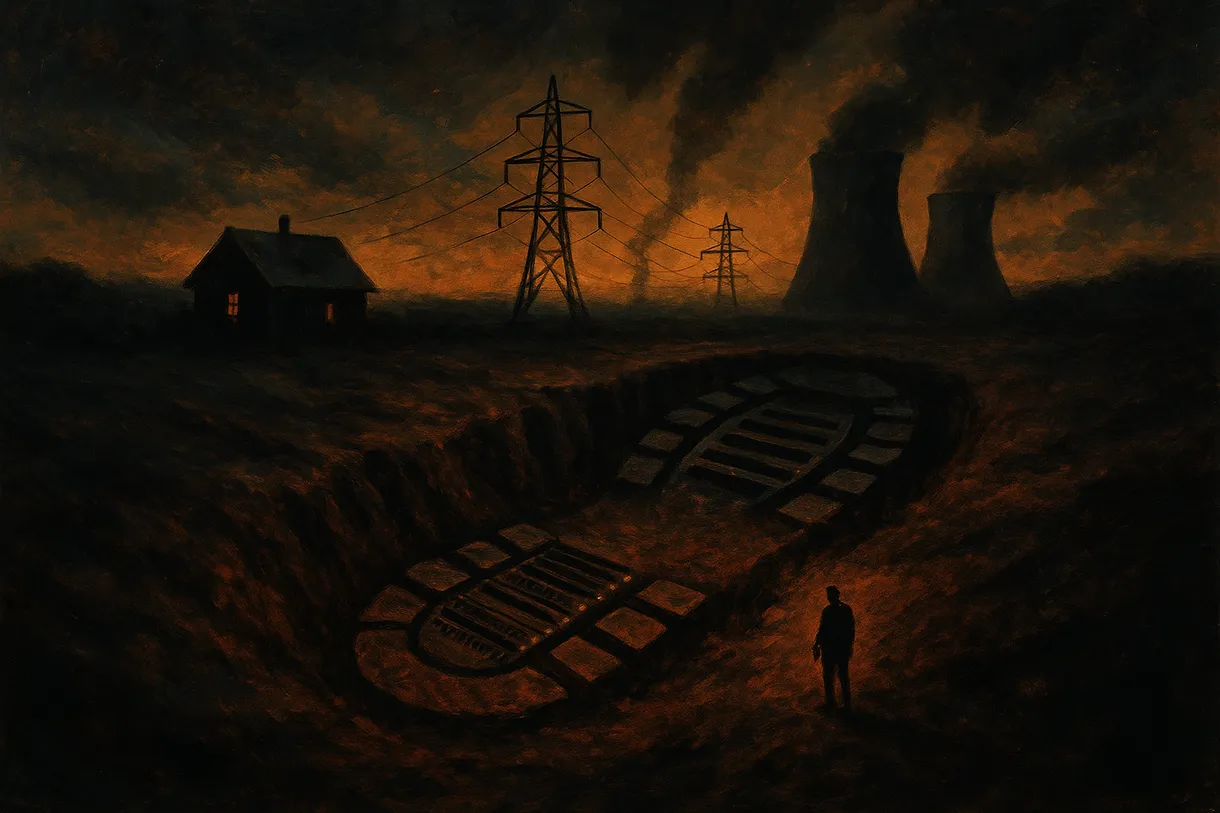
Last week the bill rolled downhill — off the labs, past the schools told to cut their lights, onto the workers with the least slack. This week we found where it came to rest: on the ground, and it left a footprint. The AI boom was sold as growth — jobs in the counties that host the racks, savings from the software that replaces the clerks, sovereignty for whoever owns the stack. This week the receipts came in, and nearly every one read backward. A cost-cutting program that saved nothing and destroyed 300,000 jobs. Data-center job math that reads like a setup without a punchline. Pollution its own reporters called almost incomprehensible. And a surveillance grid running on the same racks that spent the week sending armed police to the wrong houses. The story isn’t the promise of what the machine will build. It’s the dent it leaves — in the grid, the air, the payroll, and the yard.
The receipts came up empty
Start with the ledger everyone was told to trust. DOGE, the efficiency crusade that was going to pay for itself, is over — and People’s World tallied the exit: zero savings and 300,000 lost jobs later, DOGE is officially dead. The data centers were supposed to be the other half of the trade — pain now, prosperity later. Futurism ran the arithmetic and found the economics of data centers creating jobs are so bad they sound like a joke, while a companion piece documented pollution from AI data centers so severe it’s almost incomprehensible. In Virginia — our own backyard — the fight is no longer abstract: data centers now sit at the center of battles over taxes, environment, and jobs, and in Georgia the EPA moved to grease the skids with a proposed air-pollution exemption deal for data centers. The grievance is real enough that adversaries have noticed: officials warned that China, Russia, and others are working to inflame the debate over AI data centers — a tactic that only works because the underlying complaint is true. And the machines never paused to let the accounting catch up. OpenAI’s GPT-5.6 went live, Meta shipped Muse Spark 1.1, its first paid model, and Jensen Huang told engineers that traditional coding is dead. The invoice grows on one side of the ledger; the promised returns keep failing to post on the other.
The workers underneath
The strangest line item this week was a shortage. Slashdot flagged that America may soon face the largest labor shortage in its history even as the same week’s headlines insisted AI is coming for the jobs — because the two are the same story seen from opposite ends. The Atlantic marked a new phase of the AI-jobs panic; Slashdot relayed the warning to forget the coders — the real AI threat is in the back office; Jacobin traced how AI is quietly contributing to the gigification of work; and Robert Reich asked the question the boosters keep skipping — who’s gonna buy all the AI stuff once the paychecks are gone. Some people have stopped waiting for the debate: the WSJ profiled hard-line activists ramping up for the war with AI.
The sharpest edge lands, as ever, on public workers. Unions sued to restore DOD collective-bargaining rights, calling the rollback “chaos”. At the VA, disabled veterans say losing their telework accommodations is making it harder to keep working — the throughline from last week’s issue, still bleeding. VA officials insisted AI won’t replace human claims processors even as Democrats worry over staffing, and the department asked for more input on streamlining its benefits application forms — automation pitched as help, arriving in a building already short on people. One piece of the vise loosened: judges blocked the effort to narrow public service loan forgiveness, a rare win for the workers standing under the boot-print.
The footprint that follows you home
The same infrastructure that runs the models runs the cameras, and this week the cameras had a bad run. Flock’s automated plate readers swarmed an innocent man with armed police, and in a separate case wrongly tracked a journalist for days before sending officers to arrest him. The Bulwark reported the next expansion target: college campuses, as the deportation wars move to where students live. Techdirt watched the World Cup propel surveillance to new heights, and Meta rolled out AI glasses that record 24/7 with no indicator light — the surveillance footprint shrunk small enough to wear on your face. It’s the custody question from last month, one turn on: the labs agree on who runs the agent and disagree on what you can take back, and the same asymmetry governs the camera on the pole — someone else owns the record of where you were. The bitter footnote is that the state doing the watching can’t guard its own back office: a Puerto Rico agency exposed one million Social Security numbers, and CISA — the agency that defends federal networks — turned out to have no incident-response playbook of its own when it got hacked.
The ray of hope: a footprint you can vote out
Here’s the thing about a footprint, though — unlike a floodlight, you can see exactly where it fell, and this week people started filling it back in. The DEFLOCK movement is winning: cities and states are fighting back and passing laws that make Flock cameras a felony, and a Supreme Court ruling may turn out to be bad news for Flock, even if it won’t stop mass surveillance on its own. Labor found leverage in the same places the data centers strain the grid: power workers ran an Independence Day strike and won pensions in Pennsylvania, and Philadelphia’s IBEW celebrated a contract victory in a summer of strikes. Even the labor shortage had a humane answer hiding in plain sight: one factory that was desperately short on workers solved it by offering flexible schedules — the same accommodation the VA is busy taking away. And the week’s quietest note was almost tender: a report on what happens when an AI becomes a member of the family, the tool at its smallest and most domestic scale, sitting at the kitchen table instead of stamping the earth. It’s a reminder that the footprint isn’t fate — it’s a set of choices about where to put the weight.
The throughline
Last week the floodlight found every crack and handed the map to both sides. This week the question came back to earth: not what the machine can see, but what it costs to keep it running, and who pays in ground. The receipts settled the argument the boosters kept deferring. The savings program saved nothing and cost 300,000 jobs. The data centers promised prosperity and delivered pollution the reporters couldn’t fully measure. The surveillance grid promised safety and arrested the wrong people. The automation promised help and arrived in offices already too thin to run.
A floodlight is abstract — it illuminates and moves on. A footprint is physical. It has a location, a depth, and a name attached to whoever pressed it down. That’s the shift worth marking: the AI story stopped being about capability in the air and became about weight on the ground — the grid running hot, the air getting the EPA’s permission to be dirtier, the veteran losing the accommodation that kept him working, the journalist arrested by a camera that mistook him for someone else. The hopeful part, the only part the floodlight never offered, is that a footprint can be answered. You can pass the law, win the contract, take the strike, keep the schedule flexible. You can decide where the weight lands. This week, in a few places, people did — and the ground held.