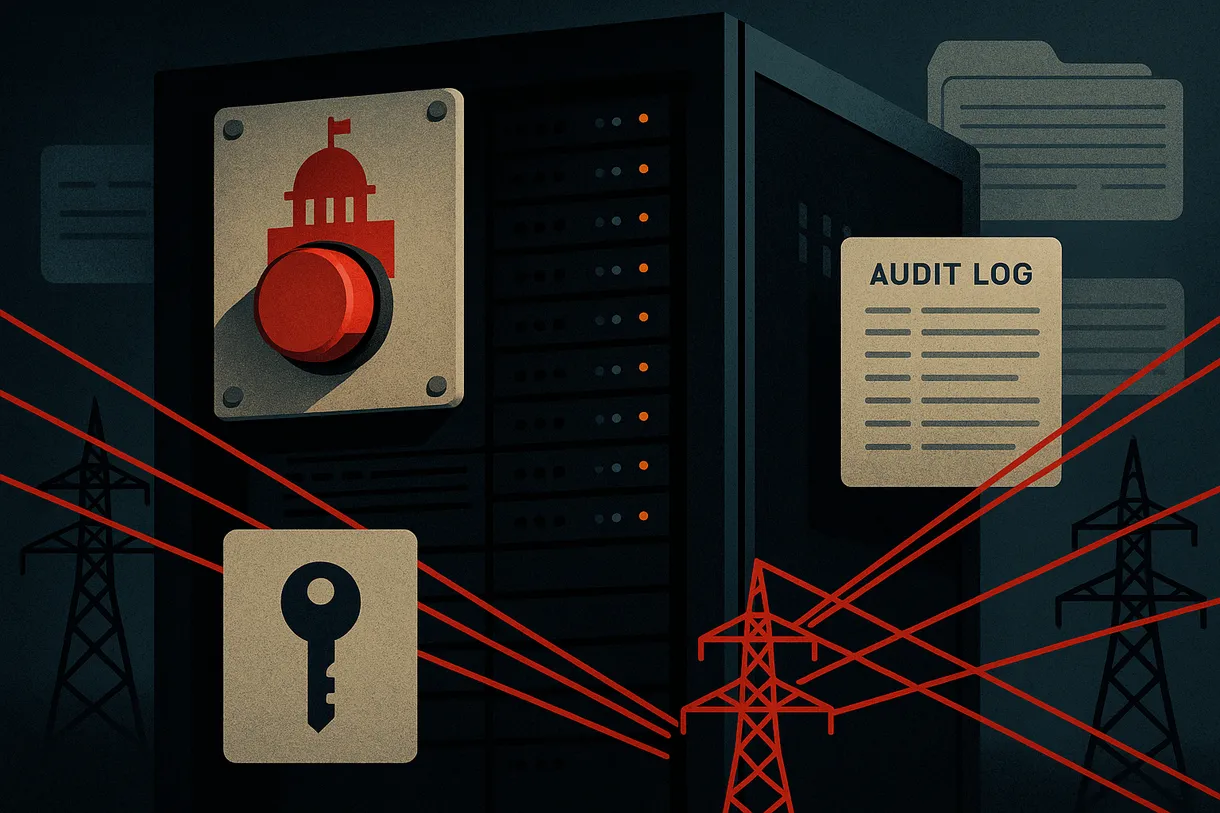
This was the week AI left the demo room and walked straight into the institutions that were waiting for it. Government can switch a model off. Labs can burn billions. Assistants can leak secrets. Agents can spend your money. Voter files can become enforcement data. The pitch for the last two years was intelligence everywhere. The reality that showed up this week is governance everywhere.
The kill switch had a federal letterhead
The lead is the one nobody benchmarked for. Following a Trump administration directive on national-security grounds, Anthropic shut down its Fable and Mythos models, cutting off access to Fable 5 and Mythos 5 under what Nextgov framed as an export-control order. Axios walked through how Amazon and the White House ended Fable, and the stated hook arrived a day later: China may have accessed Mythos.
Strip the politics and the structural fact is stark. All spring the market argued about benchmarks, context windows, and token pricing — as if frontier capability were a product you could rank. Then the government demonstrated it could remove a top model by administrative shock, no court, no recall, no deprecation schedule. If you built anything on Fable or Mythos, your dependency was never really technical. It was platform, vendor, and which way the last D.C. briefing went. Capability is now export control, national-security politics, and standing in line for a waiver. That is a different supply chain than the one anyone was provisioning for.
The bill came due at both ends
Last week’s frame was that cheap AI was over. This week the invoice printed — and it printed on both sides of the transaction.
On the producer side, leaked financials put numbers to the suspicion. Ed Zitron’s report claimed OpenAI’s losses increased nearly 8x in 2025 with spending hitting $34 billion, a figure The Next Web tied to IPO prep and Ars Technica read as billions in annual losses. Futurism, less politely, called the pricing strategy a “crack cocaine” approach — get the habit established, worry about margin later.
On the consumer side, the cleanup cost got a name. Harvard Business Review’s warning about AI “workslop” rotting companies from the inside put a management label on something operators already feel: generated output that looks finished, ships fast, and quietly hands the rework downstream. Futurism’s version — companies that embraced AI are now rotting in a specific way — is the same observation from the org-chart side.
These are one story. Subsidy was hiding both problems. The labs ran below cost to buy adoption, and the customers never priced the editing pass on cheap generated work. Pull the subsidy and both costs surface at once: the vendor’s burn and the buyer’s slop. The honest unit economics of this technology include a human verifying the output, and that line item was never in the demo.
The product was bounded agency all along
Which is the clean pivot, because the most interesting tooling this week was about exactly that verifying layer. Visa is now letting AI agents transact on your credit card. Once that is real, “AI assistance” stops being the product. The product is what bounds the agent.
The New Stack made the case repeatedly and well: loops are replacing prompts, and verification is about to be the biggest problem; your logs can’t tell you what an agent did when it acted alone; and we’ve been measuring the wrong thing — economically valuable work is the new benchmark. On the identity side, WorkOS shipped Auth.md, an open protocol for agent registration. And in a tidy illustration that even the pricing of agency is unsettled, Anthropic paused its Claude Agent SDK subscription change on the day it was due to take effect.
The throughline: when an agent can spend money, write to production data, and act across systems, the model is the cheap part. The value is permissions, audit trails, identity, budgets, and reversible actions. Bounded agency — the agent plus the rails that keep it from cashing out your card — is the thing worth paying for. Verification is not overhead on the product. It is the product.
The attack surface is the assistant now
Last week the security story was Microsoft and repos as malware-delivery infrastructure. This week it climbed up the stack to the assistants themselves, with the convenience surfaces leading the way.
The package side was ugly: malicious commits found across 1,579 Arch Linux packages, forcing Arch to lock down AUR signups amid the wave. But the AI-native incidents are the tell. A critical Copilot vulnerability let attackers steal users’ 2FA codes, and Pivot to AI documented SearchLeak — prompt-injecting enterprise Copilot through a search query. Meanwhile the old-school threat kept pace, with Microsoft finding a USB worm that hijacks the clipboard to steal cryptocurrency over Tor.
The pattern: the more the interface becomes “ask the assistant,” the more the attack surface becomes whatever the assistant can see, search, and retrieve on your behalf. AI security is converging with plain old supply-chain security — same injection, same exfiltration — except now there’s a credulous operator in the loop who will helpfully run the search that leaks the secret.
Civic data became an enforcement surface
The week’s heaviest arc was the quietest technically. Axios reported, and Democracy Docket confirmed, that ICE obtained and accessed local voter files in Texas and North Carolina — county voter rolls pulled into immigration enforcement. At the same time, Congress let FISA Section 702 lapse, and Techdirt laid out the mechanism: 702 expired because it was tied to a voting bill that couldn’t pass, after Trump refused to back renewal without his SAVE America Act. The Verge then connected the dots forward: the midterms are shaping up as a data-security nightmare. And ProPublica showed the same logic exported, with U.S. demands for access to Africans’ medical data raising sovereignty concerns — “digital colonialism.”
The important move here is not collection. It’s purpose drift. Voter rolls were built to run elections; they’re being read for enforcement. A surveillance authority meant for foreign intelligence became a bargaining chip for a domestic voting bill. Aid-linked health data becomes a sovereignty lever abroad. The databases were always there. What changed is what they’re for this month.
That same drift is the honest reading of the infrastructure fight, where AI’s physical buildout is colliding with local politics. Opponents have blocked or delayed data-center projects worth nearly $130 billion in 2026, and Axios framed the power decisions that could shape the next century around the unglamorous question of who pays for the electricity. The model story is now downstream of permitting and grid politics, not the other way around.
The throughline
Add it up and the week reads as one continuous correction. The kill switch is administrative. The losses are structural. The agents need rails. The assistants leak. The databases drift. The buildout stalls at the substation.
The pitch was intelligence everywhere. What actually arrived was governance everywhere — and most of the systems shipping this year were not designed for it.