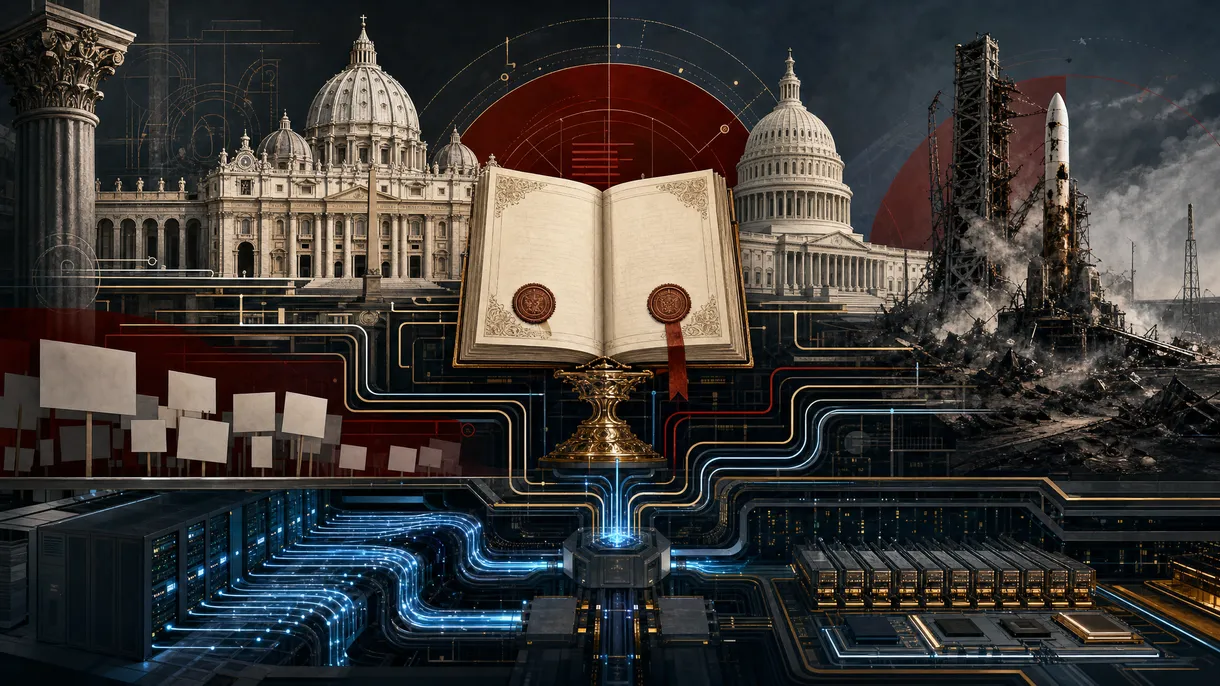
Five stories from this week that, taken together, share a temperament: the product story grew up.
Pope Leo XIV issued the first papal encyclical on AI and shared the stage with an Anthropic co-founder. Anthropic’s run-rate hit $47B while Apollo and Blackstone shopped a $36B chip-debt round. Korean unions extracted a share of the Samsung AI windfall and the AFL-CIO publicly endorsed the Pope. Illinois passed a landmark AI law while the White House moved to gag federal workers with NDAs. And Blue Origin’s only New Glenn pad exploded, taking Amazon’s Kuiper schedule and NASA’s Moon cadence with it.
Five arcs:
- The Vatican entered the AI debate.
- Anthropic became an operator, not a vendor.
- Labor moved from talk to bargaining.
- Public systems contested who controls implementation.
- The infrastructure bill came due.
1) The Vatican Entered the AI Debate
For most of the modern AI cycle, the moral commentary has been written by industry, for industry, in the register of industry. That arrangement just changed.
Pope Leo XIV released Magnifica Humanitas, his first encyclical, explicitly on preserving the human person in the age of artificial intelligence. The Vatican press rollout included Christopher Olah, Anthropic’s interpretability lead, sharing the stage. Anthropic posted his remarks the same day. The Atlantic’s editorial read called the document an attempt to draw real limits around AI and, in a follow-up, described it as the Pope doubling down on the beautiful struggle of being human against optimization pressure.
The reception immediately split along expected lines. The Verge noted the Pope is emphatically not AGI-pilled. Mistral’s Arthur Mensch went on record with a direct rebuttal on AI in warfare. Futurism noted that Olah told the Pope his lab is finding “unsettling” things inside the models — a striking thing for a co-founder to say in St. Peter’s. The Register, predictably, enjoyed the spectacle. Ars and MetaFilter argued the encyclical’s Gandalf quote was aimed at Peter Thiel. The Verge, ever helpful, pointed out that an AI detector flagged the encyclical text itself as AI-likely.
The coalition matters more than the discourse. People’s World reported that the AFL-CIO publicly endorsed the Pope’s denunciation. That is a labor federation aligning with the largest moral institution in the world against a specific deployment trajectory of AI. The encyclical does not change a model roadmap. It does change what counts as serious AI critique in mainstream and labor coalitions, and it gives non-technical audiences a frame they did not have last week.
2) Anthropic Became an Operator, Not a Vendor
While the Vatican was setting moral frame, Anthropic was setting commercial frame at sovereign scale.
Simon Willison flagged the new revenue print: Anthropic’s run-rate revenue hit $47 billion. The Next Web reported that Apollo and Blackstone are shopping a $36 billion debt deal to finance Anthropic’s chip purchases — sovereign-scale credit, structured around compute. The same outlet reported Anthropic’s Milan office opening with Generali, Pirelli and Enel as named Italian customers, and that Elon Musk has walked the Colossus deal back to a 180-day lease. A model lab is now strong enough to renegotiate xAI’s terms.
The product story rhymes. Opus 4.8 shipped with a new “Dynamic Workflow” tool; The Verge framed the headline feature as the model being more honest when it messes up, while Futurism observed that some customers found the new behavior genuinely unsettling. The New Stack covered the operational pivot underneath all of it: OpenAI and Anthropic are hiring forward-deployed engineer teams — the Palantir consulting motion, applied to model rollout. OpenAI separately gave Japan’s megabanks its newest model for cyber defense, and the Bank of Italy confirmed it is in direct talks with the major AI firms. Asana bought no-code agent builder Stack AI; Autodesk paid $3.6 billion for MaintainX to push from design into operations.
Willison’s summary fits: he thinks Anthropic and OpenAI have found product-market fit. The honest read is broader. AI vendors are positioning as critical infrastructure operators with central-bank-level counterparties, sovereign-scale debt, named industrial customers, and engineers embedded inside the customer. That is not a SaaS posture. That is utility posture, with all of the regulatory exposure that implies.
3) Labor Moved From Talk to Bargaining
Labor’s response to AI stopped being commentary this week and became contract language.
Jacobin reported that South Korean workers are demanding a share of Samsung’s AI windfall, and The Next Web called the resulting pay deal the moment Korean unions changed register. That is the first concrete capture of AI surplus by an organized workforce inside a major chip producer, and it is going to be cited everywhere from IG Metall to the UAW. The AFL-CIO’s public alignment with the Pope’s encyclical fits the same arc: labor is no longer arguing about whether AI matters, it is arguing about who gets the upside and who absorbs the deployment cost.
The rest of the week filled in the picture. LaborPress reported that NYC workers received $1.8 million in Fair Workweek Law restitution from employers. The Verge reported hundreds of prolific Wikipedia editors are threatening to strike over Wikimedia layoffs — Wikipedia’s labor question now sits next to its AI training data question. Labor Notes covered the Portland Community College wall-to-wall strike that defeated budget cuts. Massachusetts rideshare drivers formed the first US ridesharing union. The Atlantic’s argument that the LIRR strike exposes a blue-state delusion about public-sector unions is going to age into the AI debate too: any AI-mediated workforce restructuring in the public sector is a labor question first.
The two telling smaller items: Futurism reported that Nvidia’s CEO had to beg his own executives to stop telling laid-off workers it was AI’s fault, and The Register flagged that bosses are blind about shadow AI use by their own workforce. The truth-telling problem inside the firm is, increasingly, a bargaining surface.
4) Public Systems Contested Who Controls Implementation
While vendors and unions negotiated, governments moved on rules and exits.
Slashdot reported that Illinois passed a landmark AI law that takes meaningful jurisdiction out of federal hands. The New Stack covered the EU Cyber Resilience Act’s blunt position that “the AI did it” will not save you when regulators come knocking. State law and EU rules are filling the space the federal executive is vacating, and they are doing it in language that closes the easy vendor liability dodge.
At the federal level the picture is messier. Democracy Docket reported a judge temporarily halting Trump’s $1.8 billion “weaponization” slush fund, and TPM covered the broader DOJ corruption picture. Truthout reported the White House is moving to require federal workers to sign NDAs — a structural attempt to make implementation opaque from the inside. Slashdot also flagged that the Supreme Court is letting Vermont’s Meta lawsuit proceed, opening a 50-state legal wave on platform liability.
ProPublica provided the public-systems counterpart that should worry anyone modeling AI-mediated insurance approval. Its reporting on $100M billed for medically questionable vascular procedures is the analog version of what algorithmic clinical decision support will do at scale if the implementation question is left to vendors. Who chose the threshold, who explained the decision, who audited the outcome — those are the implementation questions, and they are now being contested in courts, state legislatures, and EU directorates simultaneously.
5) The Infrastructure Bill Came Due
Underneath the model story sits a capital stack, and this week it stopped being abstract.
The Next Web reported that Apollo and Blackstone are structuring $36 billion in debt to buy Anthropic its chips, and that Snowflake committed $6 billion to AWS over five years with Graviton chips at the center. Nvidia spent $6.5 billion in three months to replace copper with photonics inside AI data centers — the buildout has reached the point where the wiring itself is the bottleneck. Dell rallied on Nvidia-powered AI server demand.
The bill is also showing up where the buildout depends on orbital infrastructure. Ars Technica called the Blue Origin New Glenn pad explosion the most spectacular rocket failure since the N1. The Verge laid out the cascade: this is a major setback for NASA’s Moon plans and Amazon’s Starlink competitor. Amazon Kuiper’s FCC deployment deadline runs through this pad. NASA’s Artemis cadence runs through this pad. There was, in fact, only one pad.
The defense layer absorbed the same chip and inference stack. Picogrid raised $45M to become the neutral integration layer for modern defense; Airis Labs came out of stealth with $60M and a video-intelligence pitch. And Futurism flagged the awkward middle: corporations are reeling from huge AI costs with no clear benefits, while The New Stack noted that the fix for the cloud-bill problem exists and is being ignored because nobody trusts the rightsizing. The compute, energy and orbital cost of the AI buildout is now showing up as named capital, named outages, and named operating losses.
What to Watch Next Week
- Whether any major AI lab publicly engages Magnifica Humanitas on its merits rather than its provenance.
- Whether the Apollo/Blackstone $36B Anthropic chip-debt round clears, and on what covenants.
- Illinois as template: which state moves a comparable AI law next.
- The federal-worker NDA executive action: enforcement mechanics and AFGE’s response.
- Blue Origin’s path to a second pad, and the Kuiper FCC milestone schedule.
- Samsung’s Korean pay deal as bargaining template for IG Metall, UAW, and CWA.
- First enforcement test of the EU Cyber Resilience Act against an AI-mediated failure.
The grounded ray of hope, since you asked. The same week that produced a $36 billion chip-debt round and a $47 billion run-rate also produced an encyclical the AFL-CIO publicly endorsed, a Korean union extracting a share of AI surplus, a US state passing a real AI law, Massachusetts rideshare drivers organizing the first US ridesharing union, and Portland community college workers reversing budget cuts through a wall-to-wall strike. None of that stops the buildout. All of it is evidence that the governance and labor field is still contested, and that the trillion-dollar capex story does not get to write its own check uncontested.