Last week was about the machine entering the room.
This week was about the room changing its locks.
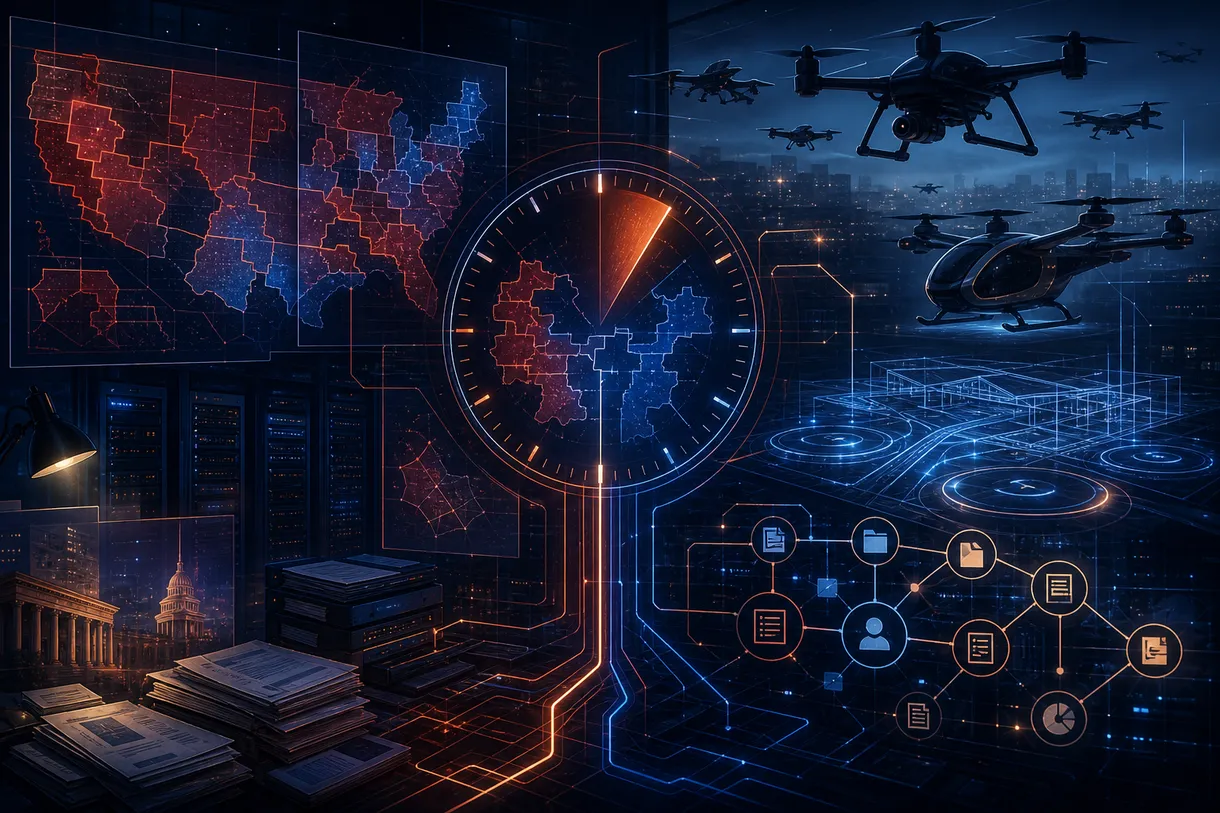
The AI story moved from backlash into rule-writing. Agents kept sliding out of demos and into the dull operational places where power actually accumulates. Redistricting fights became an election-operations problem, not a civics-class abstraction. Flying cars stopped looking like a product category and started looking like a municipal-infrastructure spreadsheet. The war-tech thread kept making the same point from another direction: the boundary between civilian infrastructure and military doctrine is not holding.
The week’s source stack was uneven — the freshest automated feed pulled too little, so this roundup leans on the strongest May 9–16 signals and uses a few May 5–8 carryover items where they clearly extend the same arc. That is worth saying once, then getting on with it. The pattern is still visible.
Five arcs this week:
- AI safety became the lobbying stack.
- Agentic AI got boring, which is worse.
- The map wars entered the countdown clock.
- Flying cars became an infrastructure spreadsheet.
- Dual-use became the default category.
1) AI Safety Became the Lobbying Stack
The useful AI-policy question is no longer whether people are afraid of AI. They are. The useful question is who gets to metabolize that fear into law.
Techdirt caught the shape of it in two pieces that belong together. First: OpenAI’s KOSA endorsement is regulatory capture with a smiley face. Then: Congress narrowed the GUARD Act, but serious problems remain. The surface language is child safety, platform accountability, privacy, and protection from harm. The deeper fight is about which institutions can afford compliance, which actors get deputized to police identity and speech, and which incumbents can turn regulation into a moat.
That does not mean the harms are fake. That is the trap. Real harms are the raw material of bad governance as often as good governance. Children do need protection online. AI systems do create new manipulation, abuse, and liability surfaces. Platforms have spent decades externalizing costs. None of that automatically makes every age gate, platform-liability scheme, or safety-branded bill wise.
Techdirt’s follow-up — let’s help children, not trial lawyers — points at the same failure mode: policy built around outrage can produce a liability machine without producing a healthier internet. The UK version rhymes. The Nation’s Tech Won’t Save Us ran a conversation with Will Dunn on the UK government’s AI obsession, while privacy groups had already been warning that UK age-gating plans could break the internet in the name of protecting it.
This is the sequel to last week’s backlash story. Backlash is a social signal. Rule-writing is a distributional event.
Once fear enters the legislative pipeline, every actor gets an angle. AI labs can endorse safety laws that smaller rivals cannot easily absorb. Governments can translate protection into identity infrastructure. Trial lawyers can find new causes of action. Moral entrepreneurs can attach old speech-control agendas to new technology. Labor critics can push democratic control, as in the broader anti-overlord politics discussed on The Nation’s conversation with Sarah Myers West. Workers can also force the issue internally: Google DeepMind workers voting to unionize over military AI deals was a useful carryover signal because it shows governance pressure moving inside the labs, not just around them.
The point is not that safety is a fraud. The point is that safety is now a political economy.
Anyone who wants better AI governance has to hold two thoughts at once: the systems are dangerous enough to require constraints, and the constraint layer is valuable enough to be captured. If you only see the first, you become useful to the incumbent stack. If you only see the second, you become useless to the people actually harmed.
The hard part is building rules that reduce blast radius without making the blast shield itself into surveillance, liability theater, or a market-entry tax.
2) Agentic AI Got Boring, Which Is Worse
The agent story gets less theatrical every week. Good. That is when it starts to matter.
The demo version of agentic AI is a model booking a trip, writing some code, or clicking through a toy workflow. The operational version is much duller: a federal office deciding whether an agent can help process work, a finance team letting Claude touch money-adjacent tasks, a cloud vendor giving agents control over virtual desktops, a database vendor asking administrators to trust AI to act on their behalf, and an integration platform selling the context layer that lets agents know what they are doing.
That is the real adoption curve.
Government Executive reported that agencies are eyeing agentic AI while readiness questions linger. The Register had AWS letting agents drive virtual cloud desktops, with the wonderfully absurd detail that the interaction could cost huge token budgets per click. Anthropic unleashed finance agents for Claude. IBM asked DBAs to trust AI to act on their behalf. Airbyte launched an agent context store. NetEase showed off inference plumbing that cut LLM cold starts from 42 minutes to 30 seconds. The Linux Foundation’s adoption of MCP, discussed by The New Stack, is another piece of the same substrate story.
Individually, these are product notes. Together, they are a permissions map.
The wrong question is still dominating the discourse: can the agent reason? The better question is: what surface did we give it, under whose authority, with which credentials, behind what audit trail, bounded by what revocation path?
A brittle agent with narrow permissions is annoying. A brittle agent with finance access, production database authority, desktop control, and bad observability is an incident report waiting for a timestamp.
The caution signs are not subtle. The New Stack covered a report warning that AI systems do not understand in the way teams often pretend they do. Gary Marcus put the blunt version in the headline: autonomous agents are a shitshow. Strip away the tone and the architectural point remains: autonomy is not a feature flag. It is a risk budget.
That is why the boringness matters. Agents will not arrive as one dramatic threshold where a system suddenly becomes generally capable. They will arrive as permissions granted one workflow at a time: read this inbox, reconcile this account, update this record, click this desktop, restart this service, draft this response, open this ticket, make this purchase.
Every one of those grants has a local justification. Most of them will be defensible in isolation. The accumulation is the story.
The mature agent stack is not the one with the most impressive demo. It is the one with clean seams: scoped credentials, dry-run modes, human review at the right choke points, durable logs, rollback paths, and an honest model of failure. Anything else is just vibes with write access.
3) The Map Wars Entered the Countdown Clock
Voting-rights coverage often gets filed as law, ideology, or democracy discourse. This week it looked more like operations.
TPM’s Virginia backs off redistricting while South Carolina plunges ahead is the clean current peg. Different states are moving on different clocks, under different court orders, with different partisan incentives, while the next election cycle is already in motion. That is not just a fairness problem. It is an administrative-chaos problem.
The Louisiana/Callais fight remains the center of gravity. Democracy Docket covered Black voters arguing that the Supreme Court erred in fast-tracking Callais and should stop the redraw. Jacobin’s Voting Rights rollback piece made the constitutional argument more broadly. Democracy Docket also tracked Alabama asking a court to allow a map previously deemed an illegal racial gerrymander and Tennessee Republicans moving to dismantle the state’s only majority-Black district, with Democrats and civil-rights leaders calling the new gerrymander racist.
The partisan discipline story is just as important. Democracy Docket reported that Trump-backed challengers defeated most Indiana Republicans who blocked gerrymandering. That turns redistricting from a legal tactic into an intra-party enforcement mechanism: draw the map, or get replaced by someone who will.
Then there is the federal pressure layer. TPM reported on DOJ demands for poll-worker information, with a Fulton County official warning that the department is trying to take over elections nationally. Even if one disputes the characterization, the operational concern is obvious. Poll-worker data, map changes, election schedules, litigation deadlines, ballot design, voter education, and county-level administration are all part of the same machine.
The phrase “voting rights” is morally correct and operationally incomplete.
What is happening is election-infrastructure drift. The rules of representation are being edited close to execution time. Courts are not just deciding abstract rights; they are changing implementation calendars. States are not merely arguing about maps; they are creating downstream work for election offices, campaigns, voters, and poll workers. National actors are not merely messaging; they are reaching into the machinery.
Administrative chaos can be a strategy. Confusion imposes costs. Delay imposes costs. Moving deadlines impose costs. The side with more lawyers, more money, more centralized messaging, and fewer qualms about voter exhaustion benefits when the machinery becomes harder for ordinary people to understand.
The next election is not waiting for the map fight to end. That is the problem.
4) Flying Cars Became an Infrastructure Spreadsheet
The advanced-air-mobility cluster was the cleanest fresh signal of the week, partly because it was so refreshingly unglamorous.
The public imagination still wants flying cars to be about aircraft: sleek eVTOL renders, air-taxi promises, quiet rotors, vertiports on rooftops. The actual industry story is starting to look more like airports, chargers, substations, maintenance crews, certifications, municipal planning, insurance, procurement, emergency services, and defense logistics.
That is progress, in the boring sense that matters.
UAM Geomatics warned of a $16.6 billion infrastructure gap that could slow advanced air mobility across the United States. Woolpert’s Naashom Marx discussed AAM infrastructure. Airbility and Schübeler announced work on EDF propulsion technology. Tohoku Air Service signed an LOI with SkyDrive for eVTOL aircraft in Japan, explicitly framed around safe and reliable regional/urban air mobility. Hewland Engineering’s motorsport heritage showed up as a manufacturing and performance bridge into AAM.
AIRO added the more explicit hinge: a full-scale dual-use VTOL aircraft platform at AUVSI XPONENTIAL.
There it is: the aircraft as infrastructure object and defense-adjacent asset.
This pairs neatly with last week’s data-center arc. Futuristic infrastructure eventually becomes local infrastructure. Then it becomes local politics.
A vertiport is not a render. It is a land-use decision. Charging is not a footnote. It is a grid question. Emergency response is not a marketing bullet. It is training, dispatch, liability, and mutual aid. Regional service is not an announcement. It is maintenance, weather, routing, certification, noise, and public trust. Defense use is not a separate category. It shapes design, procurement, and the customer base.
The credibility test for AAM is not whether the aircraft can look plausible at a conference. It is whether cities and regions can build the support layer without turning the whole thing into another elite mobility toy wrapped in public subsidy.
That is why the $16.6 billion figure matters. It turns a science-fiction promise into a capital-planning problem. Capital-planning problems are less fun. They are also where reality lives.
5) Dual-Use Became the Default Category
The week’s war-tech signal was not one battlefield. It was diffusion.
Techdirt’s why the U.S. can’t adopt Ukraine’s innovative approach to unmanned warfare systems is the right starting point because it resists the easy lesson. The U.S. does not simply need more drones or more innovation theater. Ukraine’s unmanned-warfare approach depends on institutional conditions: rapid iteration, battlefield feedback, procurement flexibility, tolerance for ugly improvisation, and a wartime urgency that incumbent defense systems struggle to copy.
That is a governance story before it is a hardware story.
The UK drone items from the carryover stack rhyme with it. A proposed “numberplate for the skies” is about identification, airspace management, and control. Skyhammer’s drone-interceptor tests in Jordan point at the counter-UAS layer. LiveEO taking a civil-infrastructure satellite stack into European defense is another version of the same migration: the tools built to observe, inspect, and coordinate civilian systems become defense assets when the security context changes.
Then AIRO puts dual-use directly on the aircraft placard. American Prestige’s episode on the Trump-Xi summit, Iran ceasefire breakdown, and CIA Mexico strike adds the geopolitical layer. Iran, China, Mexico, drones, air mobility, procurement, satellites, and prestige are not the same story, but they are increasingly being routed through the same toolchain: sensing, autonomy, logistics, communications, targeting, infrastructure, and narrative control.
That is the point. Dual-use is no longer an exception label. It is becoming the default operating condition.
Civilian aviation wants military customers. Defense wants commercial iteration speed. Satellite companies want infrastructure markets until defense budgets appear. Drone registration looks like safety until it becomes airspace control. Interceptors look like defense until they are deployed around stadiums, airports, prisons, and protests. AI agents look like office automation until they are wired into intelligence, procurement, cyber operations, and logistics.
The old category boundaries were always leaky. Now the leaks are the business model.
This is where the agent section and the AAM section meet. The critical infrastructure of the next decade is not a single class of machines. It is a stack: agents, sensors, drones, aircraft, data centers, satellites, identity systems, maps, and procurement rules. Whoever controls the seams controls the operating environment.
What to Watch Next Week
- Safety as capture: whether KOSA, GUARD, UK age-gating, and AI-safety rhetoric keep converging into identity, liability, and incumbent-compliance infrastructure.
- Agent permissions: whether new enterprise and government agent launches say anything concrete about credentials, audit logs, revocation, dry-run modes, and human review.
- Election operations: Virginia, South Carolina, Louisiana, Alabama, Tennessee, Indiana, and DOJ poll-worker demands are now one machinery story. Watch calendars, not just court holdings.
- AAM infrastructure: city/regional commitments, charging/grid plans, emergency-service integration, FAA movement, and whether the $16.6 billion gap becomes a policy object.
- Ukraine lessons: whether U.S. defense institutions absorb the unmanned-warfare lesson or translate it into slower incumbent procurement with better slide decks.
- Dual-use normalization: watch for civilian infrastructure companies quietly adding defense language, and defense vendors borrowing civilian innovation language.
The throughline is rule surface.
AI policy, agent permissions, redistricting calendars, vertiport planning, drone identification, and dual-use procurement all look like separate stories if you follow the nouns. Follow the verbs instead: authorize, constrain, delegate, route, certify, procure, identify, redraw, inspect, revoke.
That is where power moved this week.
Not into the machine in the abstract. Into the rules around what the machine is allowed to touch.