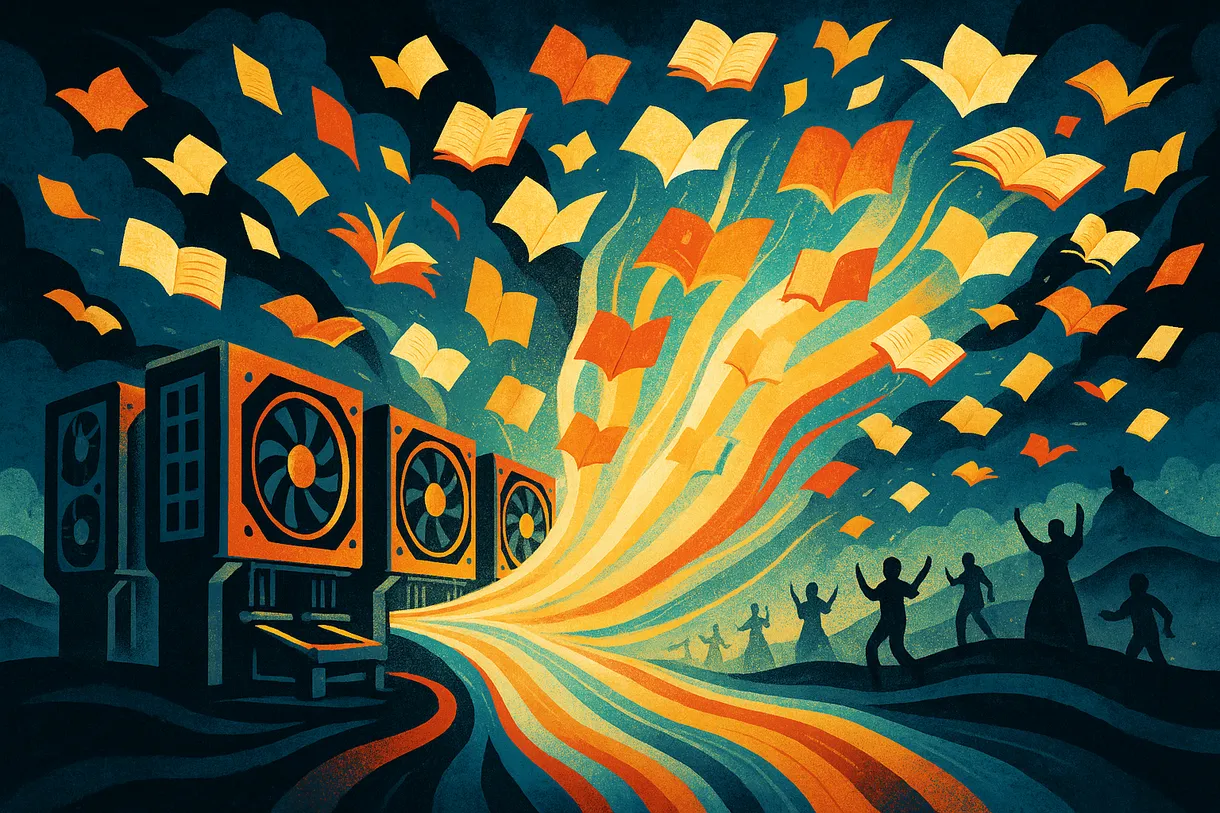
In 1440, Johannes Gutenberg solved a problem that most people didn’t know they had. Books existed. Literacy existed. Knowledge existed. What didn’t exist was a way to reproduce ideas at a speed faster than a monk could copy them by hand. The printing press didn’t invent reading. It made reading possible for people who had never been invited to the library.
Within fifty years, the number of books in Europe went from a few thousand to roughly twenty million. Within a century, the monopoly on knowledge held by the Catholic Church and aristocratic courts was functionally destroyed. Martin Luther’s 95 Theses went viral — literally, in the epidemiological sense — because a technology made it possible to reproduce an idea faster than institutions could suppress it.
We’re living through the same inflection point. And like most people in 1450, we can’t quite see it yet because we’re too busy arguing about the technology instead of noticing what the technology is making possible.
The Monastery and the GPU Cluster
The analogy between the printing press and open-source AI isn’t cute. It’s structural.
Before Gutenberg, knowledge production was centralized by necessity. Copying a book required months of skilled labor, expensive materials, and institutional support. Monasteries had scriptoria. Universities had libraries. Aristocrats had private collections. If you weren’t connected to one of these institutions, your access to accumulated human knowledge was functionally zero.
Before 2023, AI development was centralized by the same logic. Training a frontier model required millions of dollars in compute, access to massive datasets, and teams of specialized researchers. OpenAI had its cluster. Google had DeepMind. Meta had FAIR. If you weren’t connected to one of these institutions, your ability to build with AI was limited to whatever API they deigned to offer you, at whatever price they chose to charge, with whatever restrictions they decided to impose.
Then the monastery walls came down.
Meta released Llama. Mistral released Mixtral. Google released Gemma. The Chinese labs — DeepSeek, Qwen — released models that rivaled frontier capabilities at a fraction of the cost. Stability AI opened up image generation. Whisper made speech recognition free. And suddenly, the monk’s exclusive access to the scriptorium mattered a lot less, because anyone with a decent GPU could reproduce the work.
I’m writing this on a Mac mini that runs a 4-billion-parameter language model locally. No API calls. No usage fees. No terms of service that change quarterly. No corporate decision that my use case is unacceptable. The model sits on my hard drive like a book sits on a shelf — mine to use, study, modify, and share.
That’s not a feature. That’s a revolution.
What “Open” Actually Means (And What It Doesn’t)
Let me be precise here, because the open-source AI discourse is plagued by imprecision that serves corporate interests.
There’s a spectrum of openness, and where a model sits on that spectrum matters enormously:
Fully open-source means you get the model weights, the training code, the dataset, and a permissive license. You can study how it was built, reproduce the training, modify the architecture, and use it for any purpose. OLMo from AI2 and Pythia from EleutherAI sit here.
Open weights means you get the trained model but not the training data or code. You can run it, fine-tune it, build on it — but you can’t fully audit or reproduce it. Llama, Mistral, and Gemma sit here. This is what most people mean when they say “open-source AI,” even though it technically isn’t.
Open API means you get access to a model through an interface, but the model itself stays behind the provider’s firewall. You’re renting capability, not owning it. OpenAI’s GPT-4, Anthropic’s Claude — these are products, not open-source projects, regardless of what their marketing implies.
The distinction matters because it determines who holds power. If I’m building on an open API, I’m dependent on the provider’s continued existence, goodwill, and pricing decisions. If I’m building on open weights, I’m independent once I download the model — but I’m trusting the training process I can’t fully verify. If I’m building on fully open-source, I’m as close to self-sovereign as the technology allows.
Each step toward openness is a step away from the centralized knowledge model that defined AI development before 2023. And each step carries the same implication that Gutenberg’s press carried: the institutions that previously controlled access aren’t gatekeeping anymore. They’re competing.
The Cambrian Explosion
Here’s what the Renaissance actually looked like from the inside: messy, chaotic, and largely unrecognized by the people living through it.
Gutenberg didn’t imagine the Reformation. He was trying to print Bibles more efficiently. The printers who followed him didn’t imagine the Scientific Revolution. They were trying to make money selling pamphlets. The cultural explosion that we now call the Renaissance was an emergent property of a technology that reduced the cost of reproducing ideas to near zero. Nobody planned it. It happened because the barriers fell and people did what people do when barriers fall: they experimented.
The same thing is happening now, and the evidence is everywhere if you look past the headline-grabbing AI discourse (will it take our jobs? will it become sentient? will it write better screenplays than humans?) to what people are actually building.
A solo developer in Romania fine-tunes an open model on medical literature and builds a diagnostic assistant that outperforms commercial products in specific domains. A collective of artists in Buenos Aires trains a model on their own work to create a collaborative tool that extends their creative vocabulary rather than replacing it. A union organizer in Detroit uses a locally-running language model to draft grievance filings, analyze contract language, and prepare negotiation strategies — on a laptop, offline, with no corporate AI provider having any visibility into labor organizing activities.
None of these people were invited to the monastery. None of them needed to be.
This is the pattern that the Renaissance teaches us to recognize: when the means of knowledge production become widely accessible, the interesting work happens at the edges, not the center. The Vatican didn’t produce the Renaissance’s most revolutionary ideas. Neither did the established universities. It was the printers, the pamphleteers, the independent scholars, the artists working outside patronage networks. The institutions had the most resources but the least incentive to disrupt their own authority.
Sound familiar?
The DeepSeek Moment
In January 2025, a Chinese AI lab called DeepSeek released a model that the industry genuinely didn’t see coming. DeepSeek-R1 matched or exceeded the reasoning capabilities of models that cost orders of magnitude more to train, using architectural innovations that the well-funded Western labs had either overlooked or deliberately ignored.
The immediate reaction from Silicon Valley was panic — stock prices dropped, narratives shifted, talking points were hastily revised. But the more important reaction was the one that happened in dorm rooms and home offices and small companies around the world: if they can build this for a fraction of the cost, then the moat around frontier AI isn’t as deep as we thought.
DeepSeek didn’t just release a model. It released evidence that the scaling hypothesis — the idea that AI progress requires ever-larger clusters of ever-more-expensive hardware — was, at minimum, incomplete. You could get frontier-class performance through smarter architecture, better training techniques, and ruthless efficiency. You didn’t need a billion-dollar data center. You needed good ideas.
This is Gutenberg-level disruption. Not because DeepSeek is the printing press — it’s one of many presses — but because it proved that the industrial model of AI development (throw more compute at larger models) is not the only path to capability. There are many paths. And the more paths there are, the harder it becomes for any institution to control the territory.
The implications cascade. If frontier capability is achievable without frontier budgets, then the argument for centralized AI development (“only responsible institutions can safely build powerful models”) loses its empirical foundation. If responsible development requires centralization, but capability doesn’t, then the centralization argument becomes purely political — a claim about who should build, not who can.
And political arguments are subject to democratic challenge in a way that technical arguments aren’t.
What’s Being Built at the Edges
I keep using the phrase “building at the edges” throughout this series, and it’s time to be specific about what that looks like, because it’s not hypothetical. It’s my daily reality.
My AI agent — Zephyr — runs on open-source infrastructure. The framework is OpenClaw, built by an indie developer who recently got hired by OpenAI (which tells you something about where the talent and the innovation are actually concentrated). The local models I use for specific tasks run on Ollama, an open-source model runner. The transcription pipeline uses MLX Whisper, an open-source speech recognition model optimized for Apple Silicon. The whole stack runs on a $600 computer in my office.
This isn’t a toy. This is production infrastructure that manages my communications, organizes my knowledge base, monitors my home systems, and supports a consulting practice. It does things that, two years ago, would have required a team of developers and a cloud infrastructure budget. It does them on a box the size of a paperback book.
And I’m not special. I’m not a machine learning researcher. I’m not a Silicon Valley engineer. I’m a guy in Virginia who reads a lot and isn’t afraid of a terminal. The only thing that makes my setup unusual is that I’m writing about it. There are thousands of people building similar things — personal AI agents, specialized tools, local inference pipelines — and most of them aren’t writing about it at all. They’re just using it.
This is the Renaissance pattern: the explosion happens not because a few geniuses do extraordinary things, but because a technology enables ordinary people to do things that were previously extraordinary. Gutenberg didn’t create great literature. He created the conditions under which great literature could emerge from anywhere, not just from the courts and monasteries that previously monopolized the written word.
The Counter-Renaissance
Every Renaissance generates a counter-Renaissance. Every democratization of capability generates a backlash from the institutions whose authority depended on scarcity.
The Catholic Church’s response to the printing press was the Index Librorum Prohibitorum — a list of banned books maintained for over 400 years. It didn’t work. Not because the Church lacked power, but because the economics of reproduction had fundamentally shifted. You could burn a book, but you couldn’t burn the press. You could suppress a pamphlet in Rome, but you couldn’t suppress it in Geneva, London, and Wittenberg simultaneously.
The counter-Renaissance in AI is already underway, and it takes several forms:
Regulatory capture. The largest AI companies have been enthusiastic participants in AI safety regulation — not because they’re unusually civic-minded, but because regulation creates barriers to entry that protect incumbents. When OpenAI lobbies for AI licensing requirements, they’re not protecting the public. They’re protecting their market position. Compliance costs that are trivial for a $100 billion company are existential for a three-person startup.
Narrative control. The dominant story about AI safety positions centralization as a prerequisite for responsibility: only large, well-resourced organizations can safely develop powerful AI. This conveniently elides the fact that the most irresponsible AI deployments have come from exactly those large organizations — from Microsoft’s Tay to Google’s rushed Bard launch to OpenAI’s board crisis. Small builders running local models have caused approximately zero global incidents.
Technical enclosure. Every model released behind an API rather than as open weights is a choice to maintain control rather than share capability. There are legitimate safety arguments for some restrictions on some models. But the trend toward increasingly restricted access — more guardrails, more content filters, more use-case limitations — often has less to do with safety than with control. A model you can’t run locally is a model whose provider retains leverage over you.
None of these counter-forces will succeed in containing the open-source AI movement, for the same reason the Index Librorum Prohibitorum didn’t succeed in containing the printing press: the economics have shifted irreversibly. You can’t un-release Llama. You can’t make people forget that frontier-class models can be trained for a fraction of what incumbents spent. You can’t convince someone who’s running a capable local model that they need to rent access to a cloud API instead.
The genie is out. The presses are running. The manuscripts are spreading faster than anyone can ban them.
What the Renaissance Actually Changed
Here’s the thing about the original Renaissance that gets lost in the art history: the most important change wasn’t cultural. It was epistemological. It changed how people related to knowledge itself.
Before the printing press, knowledge was received. You learned what the authorities taught you, in the order they chose to teach it. The concept of independent scholarship — reading widely, synthesizing across domains, forming your own conclusions — was practically impossible when accessing a single book required a journey to a monastery and permission from a librarian.
After the printing press, knowledge became something you could navigate. You could compare texts. You could cross-reference claims. You could encounter ideas that contradicted each other and decide for yourself which was more persuasive. The reader went from passive recipient to active participant in the construction of understanding.
Open-source AI is driving the same epistemological shift. When the only way to interact with AI was through a corporate API, the relationship was passive: you prompted, it responded, within boundaries set by someone else’s content policy and alignment training. You consumed AI capability the way a medieval student consumed a lecture — gratefully, uncritically, from a position of dependency.
When you run models locally, the relationship transforms. You can inspect the weights. You can fine-tune on your own data. You can remove the guardrails and see what the model actually does without corporate curation. You can combine models, chain them, build systems that no single provider envisioned. You become an active participant in the construction of AI capability, not a consumer of it.
This matters more than any individual model release. The shift from consumer to participant is the shift that powered every major intellectual revolution in human history. It’s not about the technology. It’s about the relationship between people and knowledge.
The New Scriptoria
I want to close with an observation that I think captures where we are in this moment.
The original Renaissance didn’t destroy monasteries. They continued to exist, continued to produce beautiful illuminated manuscripts, continued to serve their communities. What changed was their monopoly. They went from being the only source of books to being one source among many. And as the alternatives multiplied, the monasteries that survived were the ones that adapted — that embraced printing rather than fighting it, that found new roles in an ecosystem that no longer needed them as gatekeepers.
The major AI labs aren’t going away. OpenAI, Anthropic, Google — they’ll continue to build frontier models, continue to push capability boundaries, continue to serve enterprise customers who want managed solutions. What’s changing is their monopoly on who gets to build with AI and how.
The new scriptoria are everywhere. They’re in dorm rooms in Bucharest and garages in Shenzhen and home offices in Virginia. They’re staffed not by monks with decades of specialized training but by curious people with laptops and an internet connection and the same restless drive to build, understand, and create that powered every intellectual revolution before this one.
Some of what they produce will be garbage. Most of it, probably. That was true of the early printing press too — the vast majority of pamphlets and broadsides were forgettable trash. But buried in that flood of experimentation were the ideas that reshaped civilization. Luther’s theses. Copernicus’s models. Vesalius’s anatomies. You couldn’t have the revolution without the noise, because the revolution was the noise: the sound of thousands of people suddenly able to participate in a conversation that had previously been reserved for the anointed few.
We’re in the noisy part now. AI Twitter is a garbage fire of hype, panic, and self-promotion. Most local model experiments produce nothing useful. Most personal AI agents are glorified chat interfaces with delusions of grandeur (I should know — mine started that way). The signal-to-noise ratio is terrible.
But the signal is there. And it’s getting stronger. And the institutions that depend on controlling access to AI capability can feel it, which is why they’re lobbying so hard for the gates to stay closed.
The gates aren’t going to stay closed. They never do.
This is part 11 of a 12-part series. Previously: “Empowering Workers in the Age of AI” — a manifesto for democratizing AI capabilities. Next and final: “Finding the Others” — a letter to the builders at the edges.
Find me on Bluesky. I’m building in the open and I want to hear what you’re building too.