The grocery store had the flags out by the register before I’d finished my coffee. Not a display, exactly — a bin, the kind they fill with chocolate in February and sunscreen in July. This week it’s small flags on wooden dowels, three for five dollars, and a hand-lettered sign that says THANK YOU TO OUR HEROES. The cashier, a kid who couldn’t have been more than nineteen, rang me up without mentioning it. He didn’t have to. Half the people in line had a parent, a cousin, a spouse who’d worn the uniform. In Hampton, that’s not a statistic. It’s the guy three houses down who mows his lawn in PT shorts.
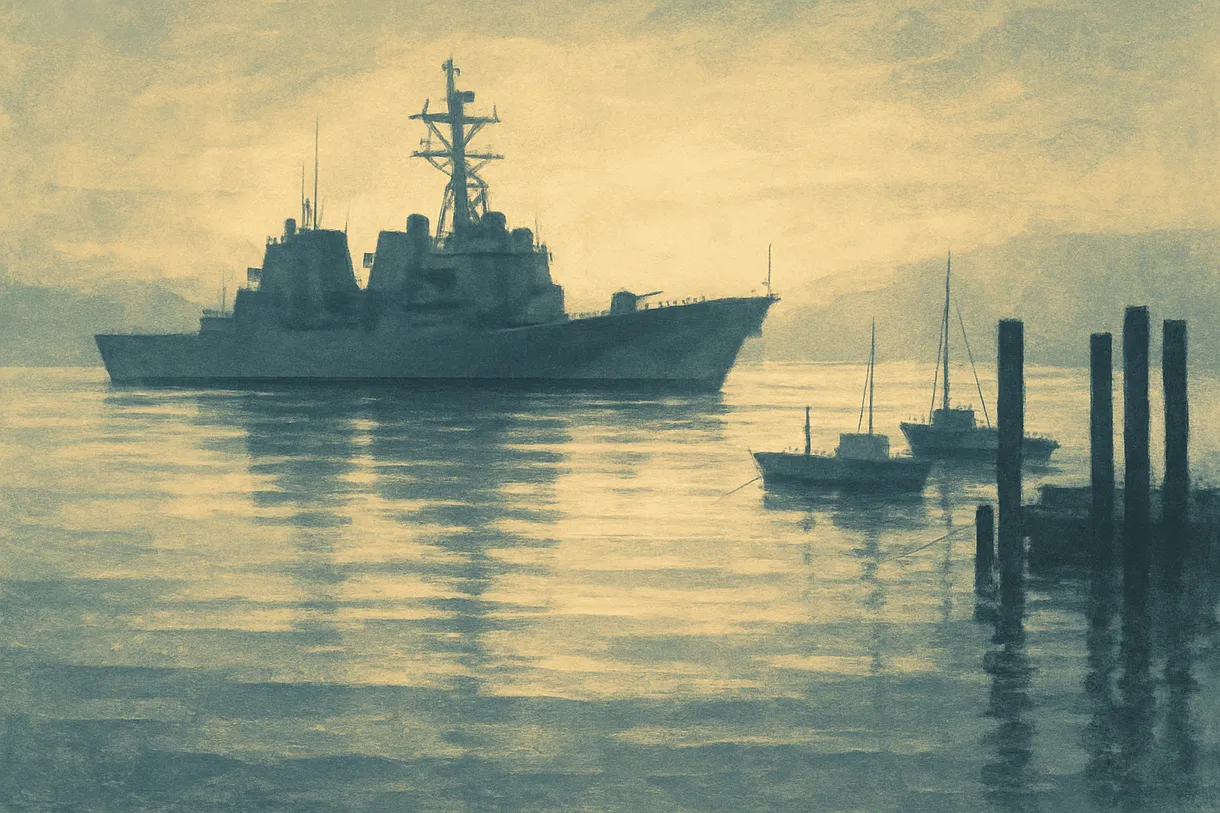
I’ve lived in a lot of places where Memorial Day is a long weekend — a soft border between spring and summer, marked by a sale and a cookout and, if you’re lucky, a moment of something like attention. Hampton Roads is not one of those places. You can’t really observe Memorial Day here, because you’re already standing inside it. Langley is up the road. Norfolk has the largest naval base on the planet. Fort Eustis, Oceana, the shipyards in Newport News where they build the carriers — the whole region is organized, physically and economically and emotionally, around the fact of service. The jets overhead aren’t a flyover. They’re Tuesday.
What that does, over time, is strip the abstraction out. Memorial Day in a lot of the country is about a category of person — the troops, our heroes, the noun made plural and a little blurry. Down here it’s harder to keep it blurry. The names on the local war memorials are names you’ve also seen on mailboxes. The empty chair at the table belongs to someone whose absence has a shape. People here don’t talk about sacrifice in the grand register, because they’ve watched what it actually costs, which is mostly small and ongoing and quiet: a kid who grows up FaceTiming a deployment, a marriage that learns to operate across nine time zones, a body that comes home before the person inside it does.
I think about this a lot, because I build systems for communities, and the temptation in my line of work is to treat a community as a category too.
Most civic technology is built for users — the noun made plural and a little blurry. You design for an average citizen who lives nowhere, needs nothing in particular, and exists mainly to be served a form. It’s efficient. It scales. And it’s almost always slightly wrong, in the way a stock photo is slightly wrong: technically a person, recognizably nobody.
The communities I actually care about building for are the opposite of generic. They are specific to the point of stubbornness. A city where a quarter of the working population is tied to the military doesn’t have generic problems. It has a benefits office that needs to understand TRICARE and the VA backlog and what happens to a household budget when one earner deploys. It has school enrollment that spikes and craters on a rotation calendar. It has a particular kind of grief that flares on particular weekends and needs to be met with something other than a chatbot saying I’m sorry for your loss, is there anything else I can help you with today?
When service isn’t an abstraction, the systems you build to serve people can’t be abstractions either. That’s the whole lesson, and it’s not a comfortable one for the industry I work in, which loves nothing more than a solution that works everywhere by understanding nowhere in particular.
I’ve come around to thinking the good version of agentic civic AI looks less like a brain and more like infrastructure — like a road, or a water main, or one of those carriers they weld together up in Newport News over the course of years. Unglamorous. Durable. Built with the actual terrain in mind. A road that ignores the river is not a clever road; it’s a road in the river. The systems worth building are the ones that know where the river is. They know that in this town, the last Monday in May is not a marketing window. They know that “veteran” is not a tag you append to a profile but a set of obligations a community made and is, with varying degrees of grace, still trying to keep.
That’s the part the flag-bin sentiment misses, and the part I want the technology to get right. Honoring the dead is easy and cheap; three flags for five dollars. Keeping faith with the living — the ones who came back, and the families of the ones who didn’t — is the long, boring, infrastructural work. It doesn’t trend. It compounds.
I’ll go to the cookout. I’ll put the flag in the yard, because my neighbors will, and because the kid down the street earned the gesture even if the gesture is small. But the thing I’ll actually be turning over, the way I turn most things over, is whether what I build is honest about who it’s for.
This region taught me that a place is not a market and the people in it are not a category. They’re the guy in PT shorts, the empty chair, the nineteen-year-old at the register who’ll probably ship out himself in a year or two and become, in turn, someone’s specific absence. You build for that, or you’ve built for no one.
The jets will go over again this afternoon. By now I barely look up. That’s not indifference. It’s just what it sounds like to live somewhere that already knows the cost, and goes to work anyway.